
Agentic commerce
In traditional e-commerce, the consumer drives every step of action and decision-making. They browse your website, click through product pages, add items to a cart, and complete checkout.
Agentic commerce fundamentally changes this experience in which AI agents act on behalf of consumers to discover, decide, and execute purchases. Instead of browsing and clicking, a user simply expresses intent in natural language - for example, "Find me a pair of waterproof running shoes under €150," "Find me the earliest departure flight next Monday to Paris" or "Order my usual groceries for delivery on Friday." The agent then takes over - discovering options, comparing products, and completing the purchase by interacting directly with your systems.
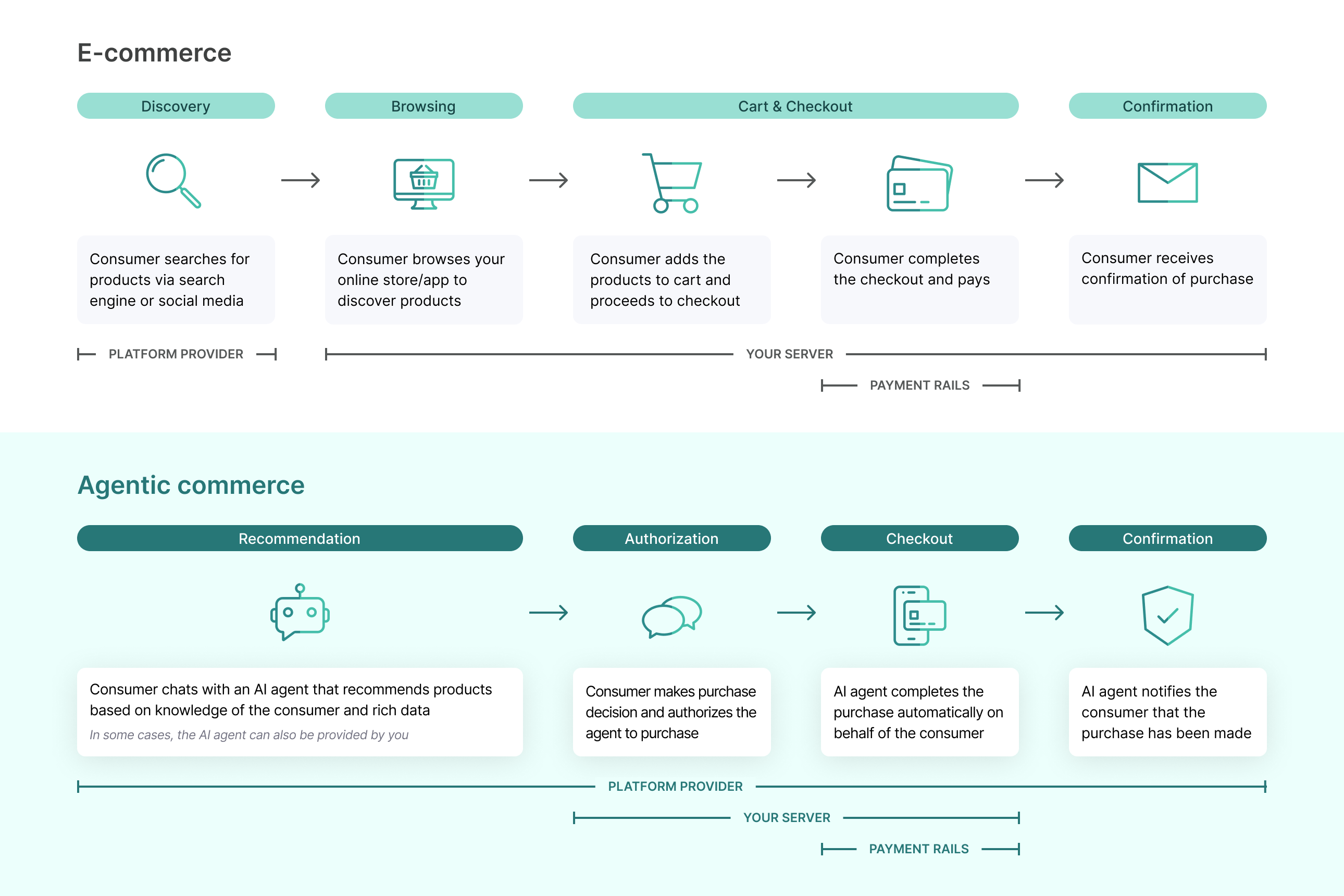
E-commerce as we know it
In the traditional model, the consumer is responsible for every step of the journey. As illustrated in the flow below, this process is linear and requires significant user effort:
- Discovery: The journey begins on a search engine or social media platform where a consumer searches for products.
- Browsing: They then navigate to your website or app to browse, compare items, and learn more.
- Cart & Checkout: The consumer manually selects products, adds them to a shopping cart, and proceeds through a multi-step checkout flow on your domain.
- Payment: Finally, they enter their payment details to complete the purchase via the payment rails.
In this model, the consumer is the active "doer," navigating between different platforms and manually executing each task.
Agentic commerce
Agentic commerce streamlines this entire process by introducing an AI agent as the primary actor. The consumer's role changes from being the "doer" to the "director."
- Intent: The journey starts with a simple conversation. The consumer prompts an AI agent with their request in natural language, like "Find me a pair of waterproof running shoes under €150." The AI agent then proceeds to discover and recommend relevant products or services by connecting directly with external systems, data, or tools by merchants or trusted 3rd party providers.
- Authorization: The consumer evaluates the proposed options. Once they select an option, they authorize the AI agent to complete the transaction on their behalf.
- Execution: The AI agent automatically interacts with merchant systems and payment providers to finalize the purchase.
- Confirmation: The agent notifies the consumer that the purchase has been completed.
This new flow is conversational, efficient, and shifts the heavy lifting from the consumer to the AI, creating a seamless, automated shopping experience.
The video above is for illustration purposes only.
Human-present vs. human-not-present agentic commerce
Agentic commerce can take different forms depending on whether the consumer is present at the moment of purchase or has delegated purchasing authority to an AI agent in advance.
Human-present agentic commerce
In human-present scenarios, the consumer remains actively involved in the transaction. The AI agent assists with discovery, comparison, and checkout, but the user reviews, confirms, and authorizes the purchase in real time. Examples include:
- AI shopping agents that guide users through product selection and checkout, e.g. “Find me the best lightweight running shoes".
- AI travel booking agents where the user confirms itinerary, price, and payment, e.g. "“Find a hotel room in Paris during Nov 16-19, budget €600”.
From a payments perspective, these use cases are closest to traditional eCommerce flows. The key difference is that the AI agent initiates the transaction with the merchant on behalf of the consumer, while the consumer remains in control of the final authorization.
Human-not-present agentic commerce
In human-not-present scenarios, the consumer delegates purchasing authority to an AI agent ahead of time. Once authorized, the agent can initiate purchases autonomously, without the user being present at the moment of transaction. Examples include:
- Monitoring prices or availability and purchasing when predefined conditions are met, e.g. “Buy me Mystic festival ticket as soon as ticket sales open”, or "Buy me this shirt when prices drops below €100”.
- Repeat purchase based on past behavior, e.g. “Order groceries based on my family’s last week consumption”.
- Complex automation request, e.g. "If my flight gets delayed over 3 hours, rebook me on the next available route and update my hotel check-in".
These use cases unlock powerful new experiences that are not possible in today's ecommerce model, but they also introduce significantly higher complexity. Merchants and payment providers must be able to trust that the AI agent is acting within the scope of the consumer’s delegated authority, the transaction accurately reflects the consumer’s original intent, and authentication and risk controls requirements are appropriately handled.
Navigating the new challenges
Unlocking the powerful benefits of agentic commerce requires addressing a new set of fundamental challenges to ensure a secure and trustworthy ecosystem:- Trust and Authorization: How do you prove that an AI agent has the legitimate authority to make a specific purchase on a consumer's behalf? How do you know the transaction falls within the scope of that authorization? How do you ensure the executed purchase accurately reflects the consumer’s original intent? Without a human clicking "I agree," a new mechanism is needed to establish and verify consent.
- Identity and Security: How can your systems distinguish between a legitimate AI agent acting on behalf of a known consumer and a malicious bot attempting fraud? How is payment information handled securely when the agent is orchestrating the purchase?
- Communication and Interpretation: How can an agent reliably understand your product catalog, real-time inventory, pricing, and business rules? Your systems need to provide structured, machine-readable data that agents can accurately interpret and act upon.
To prepare for this future, the industry is working to build new foundations for trust. Key leaders like Google and OpenAI are developing open standards to create a common language for agent-driven transactions. Google's work focuses on creating cryptographic proof of user authorization, while OpenAI is focused on standardizing the API communication between an agent and a merchant's checkout system.
As an active participant in this ecosystem, Worldline helps merchants and developers navigate this transition. By aligning with emerging standards and offering practical tools such as the Worldline Model Context Protocol (MCP) Server, we enable you to experiment with agentic commerce today—while preparing for scalable, secure adoption as the ecosystem evolves.